Ölüdeniz Babadağ Local Rules
Flying rules at Babadağ are set out in an official directive. Following them is not optional, it is a condition of your permission to fly.
Last updated 2026-09-01Flying rules at Babadağ are not unwritten custom, they are set out in an official directive. What follows is drawn from the Fethiye-Babadağ Paragliding and Hang Gliding Flight Directive and from the safety bulletin published by the Slot Service Centre. Following these rules is not optional, it is a condition of your permission to fly.
Mandatory before you fly Register at the Slot Service Centre Without a registration the turnstile at the takeoff will not open for you. Apply on the official site, then open a flight there on each flying day. Go to the registration site shmfethiye.kapadokya.edu.trOn this page
Before you fly
| Requirement | Detail |
|---|---|
| Licence | Turkish and foreign amateur pilots must hold at least a P3 certificate or licence. A P3 pilot may fly solo on a single seat wing under their own responsibility. |
| P2 pilots | May fly only from the altitude and within the wind limits approved by an instructor. They may not decide to fly on their own judgement. |
| Insurance | Amateur pilots are responsible for holding personal accident insurance and keeping it current. |
| Registration | You must register with the Slot Service Centre, presenting the required documents. Flight registration |
| Flight card | A flight card is issued through the Slot Service Centre system for every flight and carried with you in the air. |
| Foreign pilots | May fly on condition that they apply the civil aviation rules published in the Turkish AIP and in the directive. |
| Flights per day | A maximum of five flights per day. |
| Amateur tandem | An amateur pilot may not fly commercial tandem. For a non-commercial tandem flight, information and documents must reach the Slot Service Centre at least five days beforehand. |
Wind and weather limits
If the ground wind measured at the moment and place of takeoff is above 25 km/h for flights with a passenger, no flight is made. For solo flights by students the limit is 15 km/h. For live readings at the sites see the live wind page.
- Flights are made within the limits stated in the wing's own flight manual.
- The pilot assesses the weather against the flight limits and decides for themselves. If conditions change so that the limits will be exceeded, the flight is ended as soon as possible.
- Flights are made on a wing suited to the pilot's level, from sites suited to that level and within the corresponding wind limits.
No takeoff is made while a red flag is flying. Under a green flag the final decision to fly rests with the pilot and the operator. The Slot Service Centre publishes a separate meteorological assessment for each site, and that assessment is binding for the day and time window it covers.
Flying hours
- Flights are made under visual flight conditions, between sunrise and sunset.
- The last takeoff may be made 30 minutes before sunset, in coordination with the Slot Service Centre.
- Night flying is prohibited.
- No flying in rain, snow or fog.
Traffic rules in the air
Pilots must give way to aircraft of lesser manoeuvring capability than their own. During flight it is the pilot's responsibility to follow air traffic rules, to watch for other aircraft and to keep clear of them.
- The right of way rules published in the AICs for the flying site apply.
- Avoid any action that disturbs public safety and order or endangers flight safety.
- A student pilot flying under the supervision of an experienced pilot or instructor is never left alone as the last person on takeoff.
Takeoff rules
The following come from safety bulletin 2026/1 of the Slot Service Centre. The bulletin was published after an accident at the 1800 site in which an amateur pilot was injured.
- Check wind direction and speed carefully before takeoff. Do not attempt to launch in a direction that does not suit the wind.
- Do not continue the run before the wing has stabilised overhead. Avoid applying deep brake before the wing has reached flying position. That was exactly the mistake that caused the accident: early, deep brake put the wing into a stall.
- If the run does not produce a takeoff, end the run. Marking a red line on the sites for this purpose, with pilots stopping at that point, is recommended.
- Practise ground handling. Pilots flying freestyle and freeride wings in particular are advised to practise regularly to improve wing control.
- Fly a wing that matches your rating. P3, P4 and P5 pilots should respect the wing and weather limits of their level and not fly beyond them.
At the end of the 1800 site there is a slope of roughly five metres, then an access road, and beyond that the terrain drops away again in a cliff. If the takeoff is not completed safely the pilot risks hitting hard ground directly or being carried over the edge. Not starting the run until the wind direction and speed are properly met is critical here.
Takeoff discipline
The real difficulty at Babadağ is not the air, it is the crowd. On busy days there are many tandem and free flight pilots on the same site. The following are accepted without argument here:
- Before you lay out your wing, see who is behind you and in front of you.
- Do not hold the layout area longer than you need. If you are not ready, step aside.
- Once you start inflating, commit. Inflate, check, go or abort.
- After takeoff do not linger in front of the site, move out to the side of the slope.
- Tandem pilots work with a passenger and have limited room, give them space.
- If you abort, gather the wing quickly and clear the site.
The area just in front of takeoff is where you are most likely to meet others launching at the same time. Check around you before turning, make your first turn only once you are clear of the slope, and never stop to soar in front of the launch line.
When not to fly
Deciding not to fly is the most valuable decision a visiting pilot can make. If any of the following is true, the day is not for you:
- The wind is above 25 km/h, or very variable.
- The direction does not match the aspect of the site and shows no sign of improving.
- You cannot inflate the wing under control.
- You do not know the state of the landing area or the wind down there.
- The crowd does not leave you a safe area to lay out and launch.
- You do not feel right, or you are in a hurry.
Landing rules
- Landings are always made into wind and safely.
- Pilots do not enter each other's manoeuvring space.
- Priority goes to the pilot at the lower altitude.
- Landings are made in the designated areas. For their location and the approach pattern see landing areas.
- Motorised and non-motorised vehicles are not permitted into the area where the landing zones are.
- Warning signs stating that Belcekız beach is a landing zone are prepared in three languages and placed at various points around the area.
Mandatory equipment
The following are not recommendations, they are required by the directive.
| Equipment | Rule |
|---|---|
| Helmet | Mandatory at every stage of the flight. |
| Reserve parachute | Must match the weight limits. Keep track of the repack date. |
| Radio | Mandatory on every flight. |
| Wing | Must have passed an internationally valid test standard and be certified. Gliders without a check may not be used, and equipment that has reached the end of its service life may not be flown. |
| Pre-flight check | Maintenance and checks before flight are the pilot's responsibility. |
The directive makes carrying a radio mandatory on every flight, but there is no frequency agreed for pilots at this site. If you fly as a group you need to agree one between yourselves beforehand.
Prohibitions
- Alcohol. Prohibited in the 24 hours before a flight. The Slot Service Centre may test pilots; a result above 0.2 per mille counts as over the limit.
- Psychoactive substances. Prohibited. A pilot testing positive is not permitted to fly.
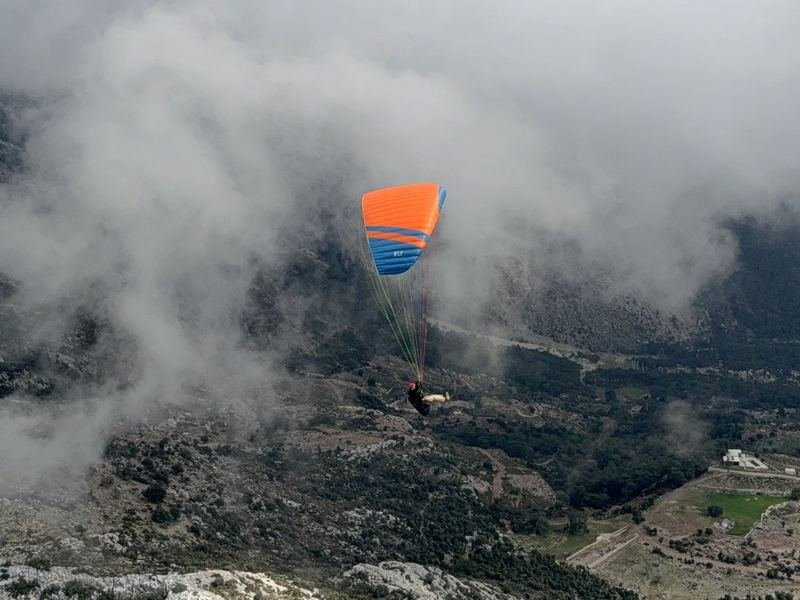
- Cloud. Launching into large cloud masses where there is no visual reference, and entering cloud in flight, are prohibited.
- Night flying. Prohibited.
- Fitness to fly. It is prohibited for anyone whose psychological or medical condition is not suitable to fly, to be sent flying or to be pressured into flying. A pilot under ongoing medical treatment may not take part.
- Outside the site. Flights are made only within the defined Fethiye Babadağ flying site.
Reporting accidents and incidents
Accidents and incidents must be reported to the Slot Service Centre and other relevant authorities as soon as possible, by the pilot involved and also by any pilot who witnessed or became aware of it.
| Slot Service Centre |
shmfethiye@kapadokya.edu.tr |
|---|---|
| Slot Service Centre Web |
shmfethiye.kapadokya.edu.tr |
| Emergency call Ambulance, fire, gendarmerie |
112 |

For the registration process and the flight card see flight registration, for site selection see takeoff sites and for the approach see landing areas.
This page is compiled from the Fethiye-Babadağ Paragliding and Hang Gliding Flight Directive and safety bulletin 2026/1 of the Slot Service Centre. The full and current text of the directive is published at shmfethiye.kapadokya.edu.tr. Rules change, check the current directive before you fly.